The purpose of the Award
The aim of this annual award is to honor five living architects, urban and landscape designers who are committed to sustainability. Their work offers a clear insight into the quest for ecologically responsible, contemporary architecture which is:
- fully in step with the ethical, civil, and social concerns of today
- innovative in the areas of ecology, energy, materials, and technology
- progressive in its search for new standards for both public and private facilities.
The 2028 Theme:
Architecture Is Circularity
For the 2028 edition, « Architecture Is Circularity » investigates architecture’s relationship to planning at every scale — from territories and cities to buildings, materials, and regenerative systems — advancing circular strategies that redefine how we design, transform, and sustain the world around us.
« Architecture Is Circularity » proposes a new way of thinking about cities and architecture as living, social, and regenerative systems, shaped by an awareness of planetary boundaries, ecological interdependence, and circular economies.
As ecological, social, and technological transformations redefine the environments we inhabit, architecture is called to fundamentally rethink its methods, values, and responsibilities. With the linear and extractive model reaching its limits, circularity emerges not simply as a technical strategy but as a new design paradigm — one that recognizes the complex relationships linking people, resources, territories, and ecosystems.
This situated approach invites renewed attention to materials, time, local knowledge, and participatory processes. It opens a broad field of experimentation in which architecture, in dialogue with science, the arts, and craftsmanship, becomes an active mediator, a driver of transformation, and a catalyst for regeneration.
Four Scales of Circularity
- Territorial Circularities
This scale explores how circular relationships between resources, infrastructures, and stakeholders strengthen local ecosystems and territorial resilience. Architecture acts as a catalyst for regenerative networks, local resource loops, and place-based development. - Process Circularities
This scale examines how design, construction, and governance evolve from linear models to adaptive, collaborative, and regenerative processes. It values participation, shared knowledge, and interdisciplinary approaches that foster continuous learning and innovation. - Material Circularities
This scale focuses on the life cycle of materials, promoting sufficiency, local sourcing, intelligent reuse, and right-tech construction. It seeks to extend material value while minimizing extraction, waste, and environmental impact. - Transformative Circularities
This scale considers circularity as a driver of systemic change. It highlights practices that rethink governance, economic models, and the existing built environment as a renewable resource capable of long-term adaptation, reversibility, and regeneration.
Eligibility and Participation
The Global Award for Sustainable Architecture™ is open to all architects, designers, urban and landscape designers around the world.
Entries may concern studied or built projects, or work related to research, writing, or experimentation, and must be submitted in English.
Members of the Organizing Body, the jury and their associates, business partners, employees, and close relatives are not eligible. Likewise, anyone involved in the preparation of the Award at any stage is not permitted to participate or assist a participant in any way.
Timeline
Award Format and Evaluation
The Award follows a single-stage, open procedure. There is only one category each year, with a previously defined theme, and five global winners are selected annually. There are no regional awards or selections.
Entries should demonstrate innovation, design quality, and a significant contribution to the United Nations Sustainable Development Goals (SDGs).
The Award does not recognize a single project, but rather a nominee’s professional, scientific, social, and political engagement.
Submissions must be made using the official template available through the Global Award submission platform.
Recognition
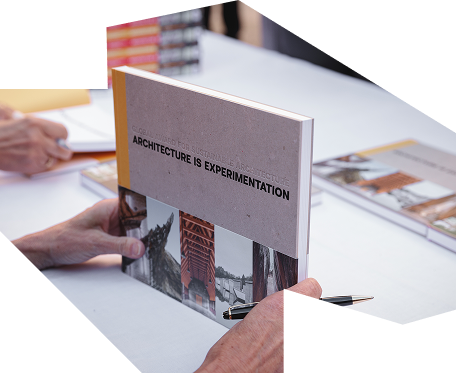
The jury selects five winners who each receive a Diploma and are invited to the annual Global Award Symposium, with travel and accommodation costs covered. Part of the recognition also lies in joining the Global Award Community, a think-tank that has become a do-tank, where laureates collaborate worldwide by researching, experimenting, teaching, advocating, publishing, and building together.
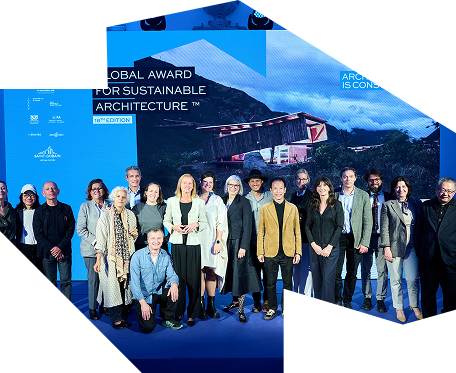
Submissions for the 2028 Global Award for Sustainable Architecture™ are now open till January 29, 2027!
January 30, 2026.
Submissions for the 2028 Global Award for Sustainable Architecture™ are now open till January 29, 2027!
January 30, 2026.
The purpose of the Award
The aim of this annual award is to honor five living architects, urban and landscape designers who are committed to sustainability. Their work offers a clear insight into the quest for ecologically responsible, contemporary architecture which is:
- fully in step with the ethical, civil, and social concerns of today
- innovative in the areas of ecology, energy, materials, and technology
- progressive in its search for new standards for both public and private facilities.

The 2028 Theme:
Architecture Is Circularity
For the 2028 edition, « Architecture Is Circularity » investigates architecture’s relationship to planning at every scale — from territories and cities to buildings, materials, and regenerative systems — advancing circular strategies that redefine how we design, transform, and sustain the world around us.
« Architecture Is Circularity » proposes a new way of thinking about cities and architecture as living, social, and regenerative systems, shaped by an awareness of planetary boundaries, ecological interdependence, and circular economies.
As ecological, social, and technological transformations redefine the environments we inhabit, architecture is called to fundamentally rethink its methods, values, and responsibilities. With the linear and extractive model reaching its limits, circularity emerges not simply as a technical strategy but as a new design paradigm — one that recognizes the complex relationships linking people, resources, territories, and ecosystems.
This situated approach invites renewed attention to materials, time, local knowledge, and participatory processes. It opens a broad field of experimentation in which architecture, in dialogue with science, the arts, and craftsmanship, becomes an active mediator, a driver of transformation, and a catalyst for regeneration.
Four Scales of Circularity
- Territorial Circularities
This scale explores how circular relationships between resources, infrastructures, and stakeholders strengthen local ecosystems and territorial resilience. Architecture acts as a catalyst for regenerative networks, local resource loops, and place-based development. - Process Circularities
This scale examines how design, construction, and governance evolve from linear models to adaptive, collaborative, and regenerative processes. It values participation, shared knowledge, and interdisciplinary approaches that foster continuous learning and innovation. - Material Circularities
This scale focuses on the life cycle of materials, promoting sufficiency, local sourcing, intelligent reuse, and right-tech construction. It seeks to extend material value while minimizing extraction, waste, and environmental impact. - Transformative Circularities
This scale considers circularity as a driver of systemic change. It highlights practices that rethink governance, economic models, and the existing built environment as a renewable resource capable of long-term adaptation, reversibility, and regeneration.
Eligibility and Participation
The Global Award for Sustainable Architecture™ is open to all architects, designers, urban and landscape designers around the world.
Entries may concern studied or built projects, or work related to research, writing, or experimentation, and must be submitted in English.
Members of the Organizing Body, the jury and their associates, business partners, employees, and close relatives are not eligible. Likewise, anyone involved in the preparation of the Award at any stage is not permitted to participate or assist a participant in any way.

Timeline
Award Format and Evaluation
The Award follows a single-stage, open procedure. There is only one category each year, with a previously defined theme, and five global winners are selected annually. There are no regional awards or selections.
Entries should demonstrate innovation, design quality, and a significant contribution to the United Nations Sustainable Development Goals (SDGs).
The Award does not recognize a single project, but rather a nominee’s professional, scientific, social, and political engagement.
Submissions must be made using the official template available through the Global Award submission platform.

Recognition
The jury selects five winners who each receive a Diploma and are invited to the annual Global Award Symposium, with travel and accommodation costs covered. Part of the recognition also lies in joining the Global Award Community, a think-tank that has become a do-tank, where laureates collaborate worldwide by researching, experimenting, teaching, advocating, publishing, and building together.
